The 26-inch mountain bike
Exactly what this clamp was sized for. An old hardtail that no longer goes off road becomes the indoor bike, and the road bike stays untouched.

Catalogue/Indoor Training/Data sheet
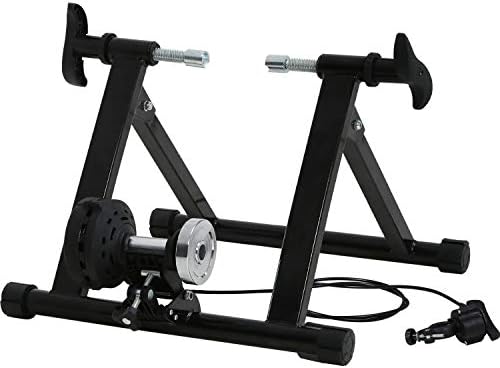
The cheaper of the two stands, set up for 26-inch wheels, with the same five magnetic levels and the same 300-pound frame.
Field notes
This is the same idea as the magnetic stand at a lower price, with the clamp set for 26-inch wheels. Five magnetic resistance levels on a handlebar lever, a noise-reduced flywheel pressing against the rear tire, an alloy and carbon steel frame rated to 300 pounds. If your bike runs 26-inch wheels, which covers most older mountain bikes and a good share of hybrids, this is the cheaper way into exactly the same setup.
Where it differs from its sibling is the wheel range and the review history: 694 ratings at 4.2 stars against more than 4,000 on the wider-fitting model. The mechanism, the frame rating and the noise figure are shared. Assembly takes about fifteen minutes with the supplied hardware, and the legs fold flat afterwards, so the stand lives against a wall between rides instead of in the middle of the room.
The dossier
The two stands in this range differ in exactly one spec that can stop the purchase working. This one is set up for 26-inch wheels; the other spans 26 inches through 700c. If your bike is a 700c road bike, the price gap between them is irrelevant. If it is a 26-inch mountain bike, this is the same machine for less money.
Structured indoor sessions run on perceived effort rather than on a number displayed somewhere. Five discrete settings give you a warm-up gear, a pair of working gears and two that feel like a climb, and you move between them from the bars. Finer granularity than that belongs to smart trainers costing several times this one.
The single adjustment that matters is how hard the roller presses into the tire. Too light and the wheel slips under load; too heavy and you burn rubber for nothing and make noise doing it. Bring it up until the tire stops slipping during a hard seated effort, then leave it alone. Check tire pressure before each session, because a soft tire changes the contact completely.
The honest ledger
Deployment
Exactly what this clamp was sized for. An old hardtail that no longer goes off road becomes the indoor bike, and the road bike stays untouched.
Households where two people ride end up wanting two stands rather than swapping bikes on one every evening. This is usually the one bought second.
Not everyone trains through a whole winter. Some just want an option for the five days in March when it does not stop raining, and this is the cheapest one on the shelf.
Owner questions
26-inch rear wheels. If your bike runs 700c, take the magnetic stand instead, which clamps anything from 26 inches through to 700c.
Wheel range and price. Both use the same five-level magnetic resistance, the same 300-pound frame rating and the same under-60-decibel noise figure at level 1.
Not to work, but a slick trainer tire is worth having if you ride indoors regularly. A knobby tread against the roller is louder and wears down fast.
The cheaper of the two stands, set up for 26-inch wheels, with the same five magnetic levels and the same 300-pound frame. Filed under indoor training — checked against the rest of the range on this sheet.
Same aisle
| Model | Headline spec | Rating | Price | |
|---|---|---|---|---|
| FDW Magnetic Bike Trainer Stand | 26″ up to 700c | ★★★★☆ 4.1 (4,040) | $55.99 | Data sheet → |