The family kitchen
Its designed post: high-traffic, messy-handed, and exactly where a no-touch lid and a sealed body earn their keep daily.

Catalogue/Home & Pet Essentials/Data sheet
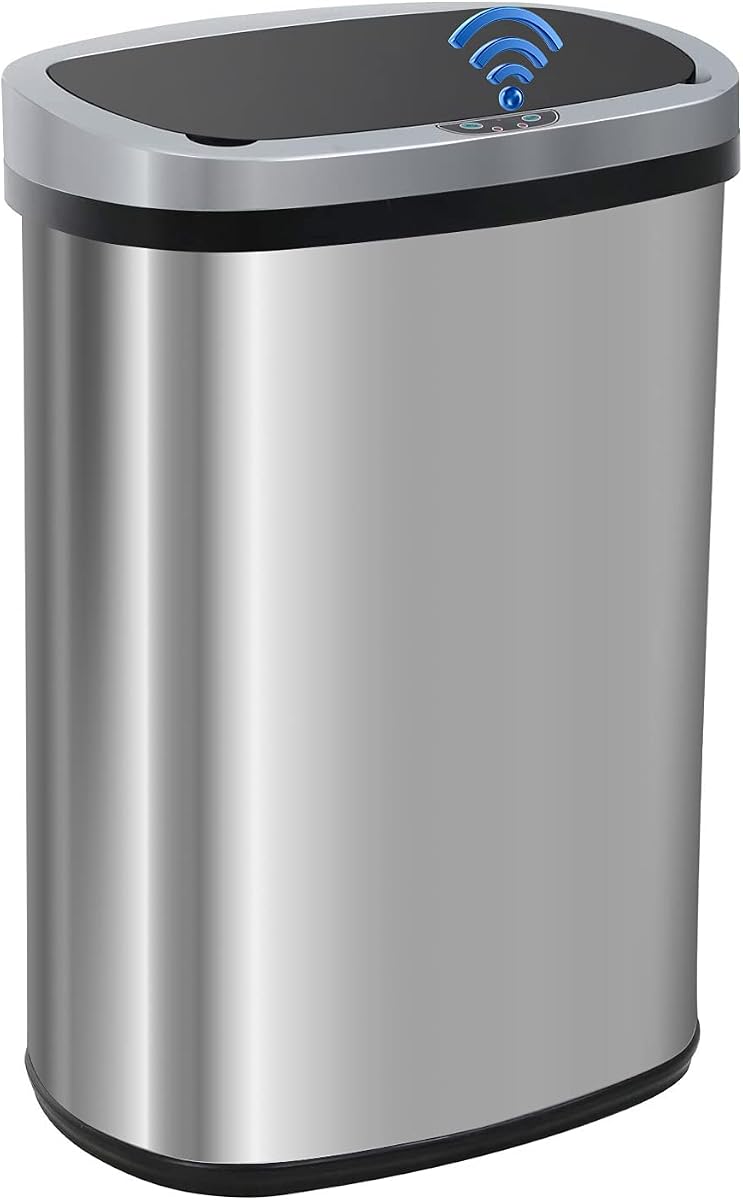
A brushed stainless bin that opens by infrared when your hand approaches and seals odor shut five seconds after the throw.
Field notes
The lid is the dirtiest part of every kitchen trash can, and this bin deletes it from the workflow. An infrared sensor watches the space above the can; bring a hand — or the chicken wrapper the hand is holding — near it, and the lid swings open on its own. Throw, walk away, and about five seconds later it closes itself. Between openings the sealed lid and body keep what is inside from advertising itself to the kitchen.
The body is brushed stainless steel at full kitchen scale: 13 gallons, or 50 liters, the standard size for a family kitchen’s primary bin. FDW sized the mouth and rim to fit ordinary 13-gallon liners — the ones already in the pantry — rather than a proprietary cartridge system, which is the quiet detail that decides the running cost of owning a sensor can. Fingerprints and sauce splatter wipe off the brushed finish, and the whole unit reads as an appliance rather than a bucket.
The dossier
The moments you use a trash can are precisely the moments your hands are worst: raw meat trays, diaper changeovers, whatever the sponge just absorbed. A pedal can still demands a balance-and-stomp; the sensor asks nothing. The lid opens for a hand, a bag of scraps or an elbow with equal indifference, and nobody in the household ever touches it — which is also why the lid stays clean.
The automation is tuned for the real cadence of kitchen work. The lid holds open while things keep arriving — the sensor re-triggers on continued movement — and shuts roughly five seconds after the zone clears. Long enough to scrape a full cutting board, short enough that the bin is never gaping open, venting, while you turn back to the stove.
A 13-gallon bin holds two or three days of family kitchen waste, and containment is the whole battle. Here the closed lid seats against the body to seal the interior, and the steel shell adds a second barrier fabric or open-top cans never had. The result is a bin the nose does not locate first — the difference between garbage in the kitchen and a kitchen that smells like garbage.
The honest ledger
Deployment
Its designed post: high-traffic, messy-handed, and exactly where a no-touch lid and a sealed body earn their keep daily.
Oversized for the room, but the auto-lid keeps paper and packaging waste swallowed and invisible rather than heaped in an open basket.
The two rooms where touch-free disposal and odor sealing stop being conveniences and start being the entire purchase rationale.
Owner questions
Standard 13-gallon (50-liter) trash bags — the common grocery-store size. There is no proprietary liner system to keep buying.
The infrared sensor opens the lid when a hand or object approaches and closes it automatically about five seconds after the area clears.
Wipe the brushed stainless body with a damp cloth. Keep water away from the sensor module in the lid; it wipes clean rather than rinsing.
A brushed stainless bin that opens by infrared when your hand approaches and seals odor shut five seconds after the throw. Filed under home & pet essentials — checked against the rest of the range on this sheet.
Same aisle
| Model | Headline spec | Rating | Price | |
|---|---|---|---|---|
| FDW 5-Tier Wire Shelving Unit | 5, each height-adjustable | ★★★★★ 4.6 (3,127) | $46.05 | Data sheet → |
| FDW 4-Panel Wood Room Divider | 71″ H × 18″ W each | ★★★★☆ 4.4 (7,646) | $65.99 | Data sheet → |
| FDW 42″ Double-Door Dog Crate | 2 (front + side), dual latches each | ★★★★☆ 4.4 (6,875) | $54.88 | Data sheet → |
| FDW 6-Tier Wire Shelf on Wheels | 6, each height-adjustable | ★★★★★ 4.5 (2,149) | $83.29 | Data sheet → |
| FDW 4-Panel Room Divider with Shelves | 70.9″ H × 17.7″ W each | ★★★★★ 4.5 (2,678) | $68.99 | Data sheet → |
| FDW Plastic Dog House, 26 × 35 × 27″ | Weather-resistant plastic | ★★★★★ 4.5 (1,096) | $65.46 | Data sheet → |